
It’s the most wonderful time of the year, and many of us are wondering some variant of the same question: what’s in the box? That being said, the anticipation of unboxing some form of unknown content is perennial. Why are gacha games so popular? Because there is an uncertain outcome, though within certain parameters. The chance of getting a rare or unusual pull is intoxicating. Why are dice rolls such a compelling mechanic? Because there is the chance for epic failures and close calls. Emergent narratives can be prompted through various generative systems.
I’d argue that the same compulsion for uncertainty is being triggered with generative AI. There’s a similar feedback loop every time ChatGPT or Midjourney is fed a prompt: what’s it going to come up with this time? What if I change the wording of my prompt slightly? Can it understand a joke? What if I feed it my teenage diary entries?
I make these points because I recently wrote and ran a LARP themed around AI and generativity. The experience led me to reflect on why prompt engineering is so compelling, and why LARP and other improvised creative activities are a great space for exploring it.
No weddings and a funeral
For me, 2024 was a year bookended by LARPs. It started with me role-playing on a boat, ended with me writing my own scenario, and even one where I pretended to be a ghost possessing a wall at some point. I’d been curious about LARP ever since a friend on my PhD course introduced me to a local university group. That was a more traditional, combat-heavy fantasy setting, and I spent a rainy afternoon in York pretending to be a statue and a vaguely threatening monster made of goo. I was instantly hooked.
LARP, broadly speaking, is role-play that involves physically acting out scenarios. It overlaps with tabletop role-playing and improv theatre, and has a reputation for being a pastime involving people dressing up as orcs and running around in fields. Personally I tend to prefer more surreal and psychological LARPs, but there’s a whole spectrum of experiences out there.
After taking part in an incredibly intense LARP set over several days based on the video game Disco Elysium in September, I no longer felt like a bystander to the hobby. More importantly, with actual experience playing several different LARPs and appreciating the puzzle box of game mechanics, set dressing and narrative design involved, I felt like I could take a decent stab at writing one myself.
As luck would have it, Stockholm Scenario Festival needed some short one hour scenarios, and thus I ended up writing Funeral For An AI God, a LARP about well… attending the funeral of an artificial intelligence deity. Naturally.
Prompt delivery

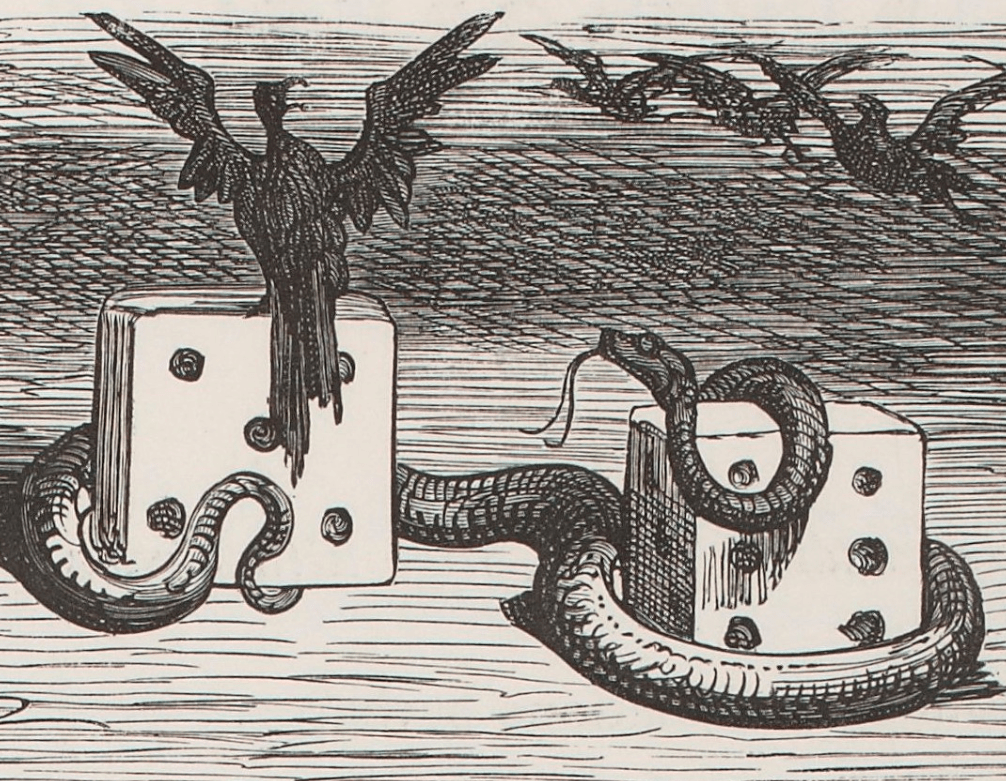
In the lead up to the festival, I spent a lot of time agonizing over one particular mechanic I’d conjured up for Funeral, mainly because it was causing me a logistical headache. As part of the opening workshop for the LARP, players first roll a colour dice and then a d4 in order to pick three memory prompts that their character can potentially share about the AI deity Fortuna during the service. Not only would I be running my LARP for the first time, but it would also be facilitated by three other GMs simultaneously. With four characters in each playthrough, I had to create sixteen bespoke dice and have multiple iterations of various other props.
The writing of the four character prompts almost felt like an afterthought, but I was intent on creating tension between the four of them that might make for interesting play. As it happened, it was the reactions to these character prompts, and not the memory generation mechanic, that was the most rewarding for me as both a game designer and writer.
Throughout my life, I’ve had very few instances where I’ve seen characters I’ve created come alive before my eyes. Hearing one LARPer proclaim that they’re a “rich bitch” after reading their character prompt for Shelley, The Haunted (“The Shelley family are rich techno-aristocrats”) or another adopt the nervous mannerisms of an addict (“Chandra, The Unlucky. You have lost everything to gambling”) felt like magic. To be sure, you can more generally get this kind of experience if you write for performers, but that’s not a privilege that’s ordinarily accessible for most people.
I think the experience felt all the more miraculous because I was able to go from concept to performance so quickly. The analogue nature of LARP is akin to paper prototyping in that I can iterate on a design quickly, bring it to a festival and then get live feedback from players. I work on and research primarily digital games, and translating an idea into a digital space can feel sluggish. Watching LARPers interpret my characters felt like a breath of fresh air.
What’s more, it wasn’t a case of writing lines to be followed: these character descriptions were primers for the players to elaborate on and inhabit. The thrill of seeing how people would react to these prompts reminded me of that same thrill of uncertainty I’d seen people display when they screenshot a zany response from ChatGPT.
All that remains…
To return to the theme of unboxing, there’s that Greek myth of Pandora opening a box and releasing all the evils of the world on humanity. Still, that box had a silver lining, because hope remained. One of the arguments I’ve heard of embracing ChatGPT is that “the box is already open” – it’s too late to resist. On the other hand, many critics of generative AI sneer at the concept of “prompt engineering”. Yet, I think it’s precisely this impulse to poke at these generative systems that holds the nugget of hope after the proverbial unboxing.
It’s not that the desire to be creative isn’t there, or to engage with the underlying source material that generative AI ingests. It’s that these products create a context for people to explore that impulse in a way that is apparently accessible, low stakes and socially acceptable. I can’t suggest that everyone start writing LARPs, but imagine if we lived in a world where small-scale personal artistic practise was materially supported by our governments and not the enabling of huge companies wanting unfettered access to that very same creativity for profit.
There’s so much joy in the creative process, and in prompt engineering for people.
You’ve opened the box. Now make a new one.
 Florence Smith Nicholls