
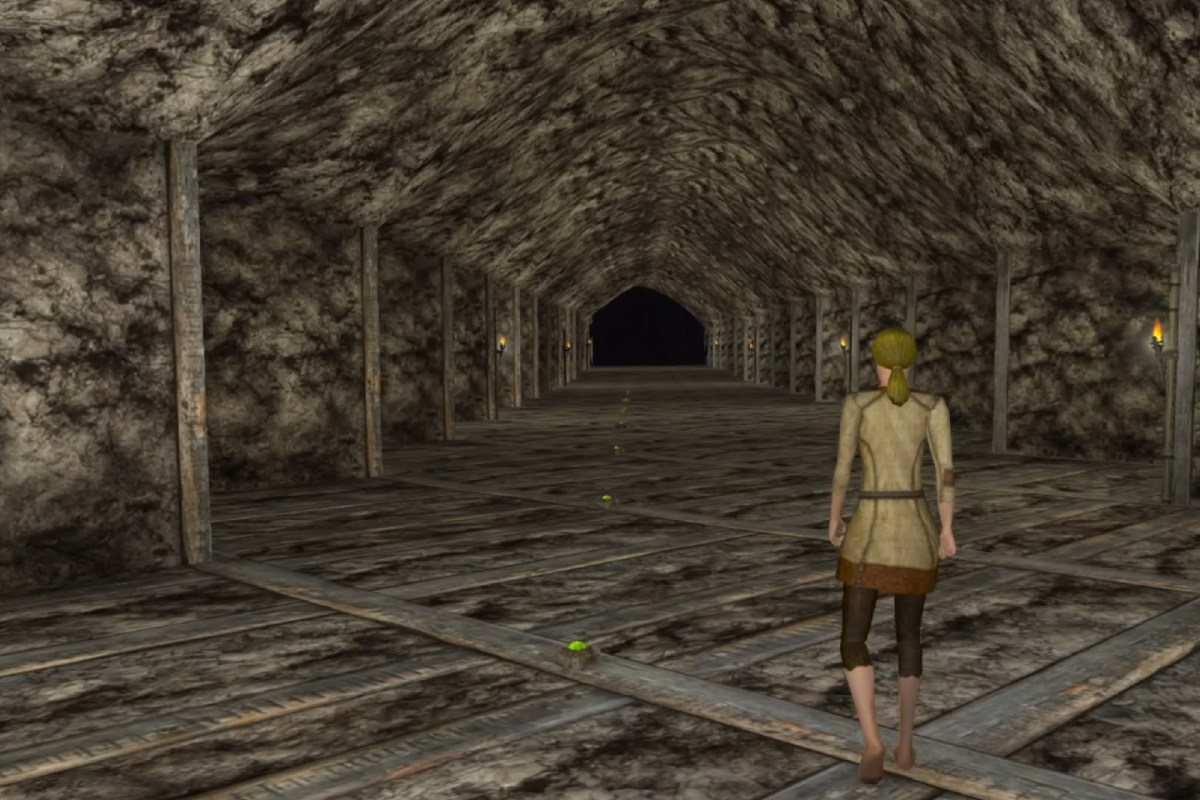
According to Phil Spencer, Xbox’s generative AI model Muse is the answer to game preservation. In an announcement post, Xbox states that “we are exploring the potential for Muse to take older back catalog games from our studios and optimize them for any device. We believe this could radically change how we preserve and experience classic games in the future and make them accessible to more players.” I’ve written in the past about generative AI as a black box archive, and in the case of this iteration of Muse, this is apparently a black box archive of “data from around 500,000 anonymized gaming sessions (over 7 years of continuous play)” of the multiplayer game Bleeding Edge.
Last month, Bleeding Edge had a peak of 2 online players according to SteamDB. It stands empty like an abandoned mall, its former self resurrected through a pastiche of player recordings murmuring to each other.
Critical Karaoke
Speaking of empty orchestras,* last Friday I did a karaoke performance about my PhD research. I’m currently in Sydney for the Hunt-Simes Institute in Sexuality Studies, a two week experimental workshop about embodied learning in the queer classroom. As part of this, Professor Karen Tongson introduced us to the concept of “critical karaoke,” in which you have to present a topic in the time it takes for a single song to play, speaking or singing over it in the background.
I bring up critical karaoke in relation to game preservation for several reasons. Firstly, my own performance was very much about the subject, and why it’s relevant to queer studies. Secondly, and as I said in my performance itself, a karaoke performance is much like a game playthrough – it’s an ephemeral, fleeting thing. How best to pin the proverbial butterfly to the corkboard?
Playful Archive
In the subsequent discussion, Karen and I were asked what we thought would be the best way to record critical karaokes. I mentioned how, just as in games, different techniques could be used, whether that be film recordings or note taking. Karen challenged why we should necessarily record them at all, instead pointing out that one of their defining qualities is that they are of the moment, and can just exist in that moment. This is something I’ve been thinking about a lot with my own work, questioning my own archival fever.
Rather than providing a record of my performance, I want to reflect on the process that went into creating my critical karaoke. I chose the song Boys by Charli XCX because it samples the coin collection sound effect from Super Mario Bros, and sampling also feels like a form of archiving. I wanted to speak both with and against the lyrics of the song, so timing was important. I wrote out all the lyrics by hand in a small notebook, with the words I would perform on the corresponding page so I could keep time.
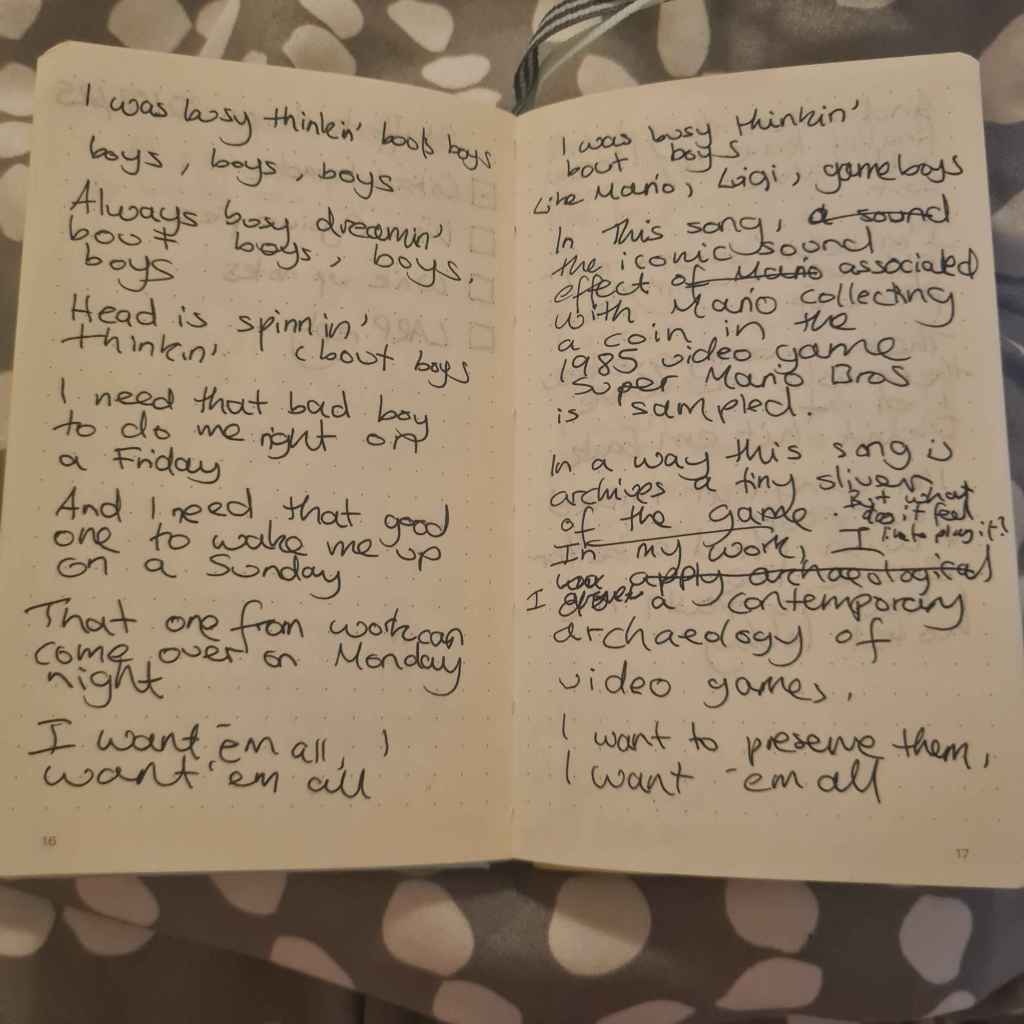
Here’s the full transcript:
I was busy thinkin’ bout boys, like Mario, Luigi, game boys.
In this song, the iconic sound effect associated with Mario collecting a coin in the 1985 video game Super Mario Bros is sampled.
In a way this song archives a tiny sliver of the game. But what does it feel like to play it? I argue for a contemporary archaeology of video games.
I want to preserve them- I want em’ all.
We need to record what it feels like to play games now, so that we can understand them in the future.
Them twenty questions I ask my participants on a walking interview in a game- I want to understand their embodied heritage in a virtual world.
After all, a playthrough of a game is very like a karaoke performance of a song, it is fleeting, ephemeral, personal.
I create anticipatory archives of games using photography, videography, field notes, and map making – all methods used by archaeologists irl.
You might say, I never see you in the club, well I never see you in the 2006 MMO Wurm Online.
I’ve been very busy thinkin’ about gamer boys, gamer bros – the people who games supposedly belong to.
Collect the coins, get stronger. WIN.
But we can sing, and play differently.
I’d argue that even a hardcore masculine game like Elden Ring, which is notoriously difficult, actually belies queer kinky pleasures – the relinquishing of control.
They say games are a series of interesting choices.
Well I choose to take them seriously.
Who will record the queer gesture, queer traces, while cruising the video game?
Dare I say it, I was busy dreamin about all sorts of boys, maybe even trans masc boys.
Non-hegemonic queer masculinities in games, elsewhere, otherwise.
The Bleeding Edge of Game Preservation
My favourite line in my critical karaoke performance is the one that references Wurm Online– getting a room full of queer people to laugh at a joke about an obscure MMO is a high I’m not sure I’ll ever reach again. It was also a lovely full circle moment – Wurm Online is the game in which I’ve demonstrated that walking interviews (or “go-alongs”) can be applied as a rich qualitative games preservation method. And I was introduced to the go-along methodology two years ago by Dr Sam Stiegler, the first time I attended the Hunt-Simes Institute.
If you peruse the Nature article that Phil Spencer’s announcement is based on, you’ll notice an interesting detail: it does not mention game preservation. At all. The original research was not designed with that purpose in mind. This is why it does not consider the cultural context and idiosyncrasies of the data that the model is trained on in any depth. The paper states that the player data from Bleeding Edge was recorded between September 2020 and October 2022. SteamDB shows that monthly player count during this window peaked at only 32 people.
The low player count doesn’t make Bleeding Edge less valid for game preservation; if anything it might make it weirdly more interesting. Who were the people still logging on even when player numbers reached the single digits by 2021? Were they dedicated players who knew each other, or new players sporadically trying it out? The Microsoft announcement of the new generative AI frontier for game preservation is PR buzz, which indicates more about the potential for it to be marketed as a product, than the actual results of the underlying research.
Preservation, like game development, is process, is labour. It’s a song and a dance, and if you can only understand it is a marketable output, well. There’s no orchestra, only emptiness.
* The term “karaoke” is a compound of Japanese kara 空 “empty” and ōkesutora オーケストラ “orchestra.”
24/02/2025: I edited this post after erroneously claiming that Phil Spencer said the quote in the first paragraph. It was actually written by Fatima Kardar (Corporate Vice President, Gaming AI) in the Xbox announcement.
 Florence Smith Nicholls
“well I never see you in the 2006 MMO Wurm Online” is indeed a fab line. Great piece!
LikeLike