
In live action roleplay “everything is a designable surface” according to Johanna Koljonen. This means that every part of the LARP experience, from Facebook posts advertising the event to character sheets, can be consciously designed. As embodied play, LARPs are ephemeral experiences that are as easy to capture as water in a sieve. Part of the point, arguably, is that they are very much constructed in the moment, and it can be hard to remember what happened to your own character let alone how other plotlines played out.
The LARP community, naturally, has developed various archival practices. Many LARPs and LARP events hire a professional photographer to capture dynamic and interesting moments of play, and to create character portraits. These often, in turn, become part of the marketing for the LARP as well. There are online wikis, such as Nordic Larp Wiki and Alexandria, a really vast online library of role-playing games, board games and LARPs. There have even been LARP film projects. These archival methods all have their own affordances; photos can capture a vibe or document costumes and settings well, but are by their nature static. Online wikis and libraries are useful for reference material, but they don’t tell you how a LARP actually played out. Film is more dynamic but could be intrusive and will inevitably affect how people roleplay if they know they are on camera.
My PhD research focuses on applying archaeological theory and method to video games, for narrative design and game preservation purposes. As I’ve become more involved in the LARP community and run my own scenarios, I couldn’t help but think about how this might also be applied to LARPs and LARP preservation. If we have archaeological artefacts, couldn’t we have archaeological… Larpefacts?
Introducing Larpefacts
Broadly speaking, in archaeology an artefact is an object that has been made or modified by humans in the past. This could be anything from a sherd* of pottery, to a bottle cap, or a rock with a face carved into it. Though Larp artefacts are the product of the recent past, that makes them no less relevant for archaeological study.
Perhaps the most obvious Larpefacts would be costumes and props. This especially makes sense for bigger blockbuster LARPs and combat heavy LARPs in which bespoke armour and weapons are a core part of the experience. There’s considerable precedent for curating these kinds of materials in the performing arts in general – for example the V&A’s Theatre and Performance Archives holds costumes, memorabilia, correspondence and even puppets.
But what about smaller scale LARPs with limited props and scenery? Earlier this month I went to The Smoke, London’s chamber LARP festival, and there were no props required for any of the scenarios I took part in. Clearing out my bag over the last week, I found not only my name tag for The Smoke but other LARP events as well, and that got me thinking – even name tags are a designable surface. And name tags are really interesting Larpefacts.
Archiving the “designable surface”
Have a look at the name badges below. What can we learn about the events they’re associated with from their design?
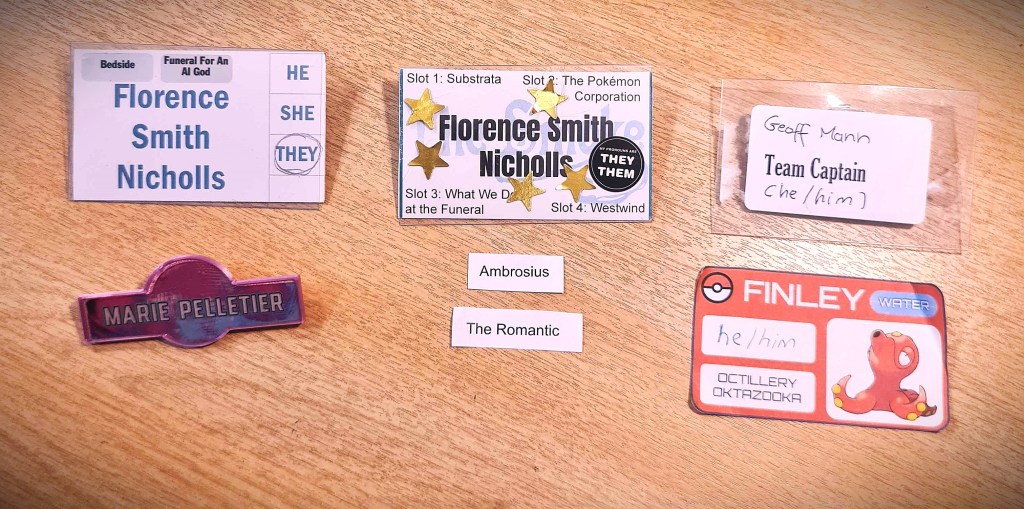
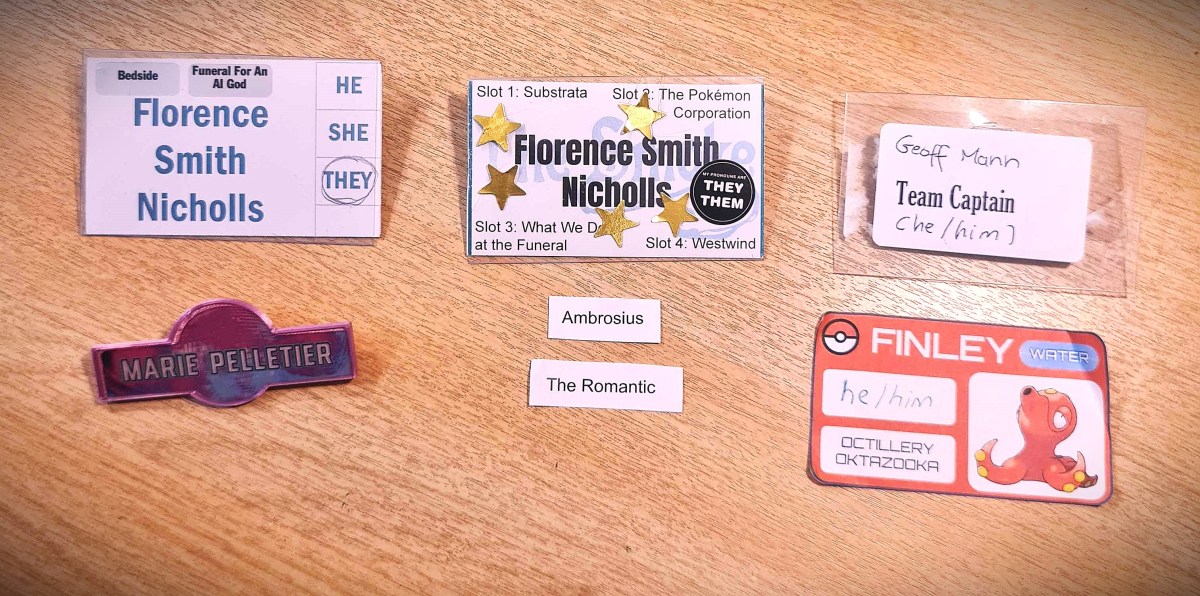
Take the name badge in the centre, for instance. This was for The Smoke, which is why you can see the titles of the four chamber LARPs I participated in listed around my name. There are physical additions: a pronoun sticker which is indicative of the LARP community being conscientious about how people refer to each other. The stars were given to me by one of The Smoke’s organisers who gifted them to people just for the fun of it. My name badge for the Stockholm Scenario Festival (top left), however, is more sparse- I only took part in the two LARPs that I actually ran myself!
LARP name badges can tell us personal stories, and are also indicative of the design concerns of specific events. Further proof that name badges are interesting designable surfaces is that some LARPs I played at The Smoke had us temporarily adapt them. For example, I slotted the “Finley” name tag into my badge for The Pokemon Corporation LARP. The reason why I have two small slips of paper marked as “Ambrosius” and “The Romantic” respectively is that we were asked to pick our name and epithet and slot them into our name badge for What We Do At The Funeral, a camp vampire LARP. My temporary identity literally overlaid my everyday one.
Not all LARPs at The Smoke went this route though. In the case of Substrata, a LARP about a class of teenagers going to a cave and interacting with the fae world, I had a separate name badge for Geoff Mann, “The Team Captain” (top right). During Westwind, a non-verbal LARP, my character didn’t even have a name, let alone require a badge. Then there’s the real outlier in this picture, a bespoke name badge for the character I played in the international LARP 97 Poets of Revachol. Its design hints at the high production and aesthetic of Poets.
Non-diegetic Larpefacts
Name badges are also emblematic of the kinds of play culture and etiquette that are common in LARP spaces. In everyday life, you’re usually only required to wear one in a work setting. Because LARPs are in-person and it’s likely you will be interacting with people you don’t know, they’re an essential part of the non-diegetic designable surface. They’re both so mundane as to be invisible and yet so crucial that you’ll feel naked without one at a LARP event. Name badges act as a social lubricant, making it easier to approach people and strike up a conversation about what they’ve been playing. They’re also just purely functional, helping players and runners to keep track of people.
Unlike other kinds of Larpefacts, name badges are also likely single use- my Smoke 2025 badge only works in its original context. They’re likely thrown away, unless you’re a LARPer like me who likes to hoard them as souvenirs.
Collecting LARP badges also has parallels with curatorial work I did at the British Library around collecting contextual material for interactive narrative apps. I archived blog posts, put together bibliographies and development documentation for The Cartographer’s Confession, a location-based game that’s been removed from the app store. Even if the original app isn’t accessible, these contextual materials can help us to understand how it was developed and received. The same can also be said for Larpefacts.
What’s in a name (badge)?
There’s much more to expand on with the potential and limitations of Larpefacts like name badges. Less character-driven LARPs like the non-verbal one I mentioned earlier are much less likely to engage with them as a designable surface. On the other hand, I haven’t really delved into what we can learn about individual LARPers from the roles they take on across multiple events as evidenced by name badges (I’ll leave the reader to derive what they will from my own little assemblage).
As I continue with my doctoral research and develop my practice as a LARPwright, I’d like to expand on the idea of Larpefacts and archiving the “designable surface.” What does it mean to design a LARP with future preservation in mind? How can the archive intersect with the LARP play space? Does anyone actually think name badges are interesting to think with, or is it just me?
With these questions in mind, if you have any larpefacts you want to share, especially name badges, please do get in touch!
*Yes, the correct term for a fragment of pottery is sherd, not shard. This is not a typo.
 Florence Smith Nicholls