
“I will punish all who leap over the threshold, who fill the house of their master with violence and deceit.”
Zephaniah 1:9
My mind is stuck on a line in the latest episode of Severance, turning it around and around like a revolving door. If you are familiar with Severance, fear not, I will only refer to minor spoilers. If you aren’t, all you really need to know is that Severance is a sci-fi psychological thriller TV series which follows the employees of Lumon, a corporation with a “severance” programme in which an employee’s mind is split in two: an “innie” that only has memories of their workplace hours, and their “outie” with no knowledge of what their workplace counterpart does.
In Season 2, Episode 2, there’s a scene where Outie Dylan is interviewing for a job after being fired from Lumon. The interviewer makes the following remark about that company:
“And they make their doors in-house. It’s fucking hubris.”
This episode, in contrast to the previous one, focused singularly on the experience of the Outie characters. While the Innie scenes in Severance often explore the surrealism of Lumon, I really enjoy how the Outie ones contextualise a world in which a company like that exists. Lumon is so territorial, they’ll even make their own doors – but then that makes sense – they create their own employees in-house, after all.
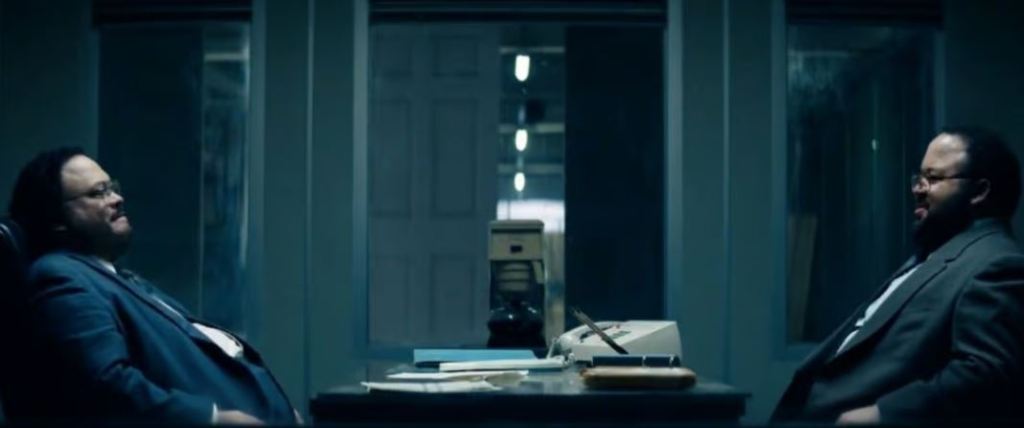
This mundane worldbuilding detail invites us to think about the infrastructure of Lumon and the design problems they have in needing to demarcate space for severed and unsevered employees. It also got me thinking about one of my favourite game design articles.
When is a door not a door?
In The Door Problem, Liz England uses the humble door as a way to explain the intricacies of her role as a game designer:
“Premise: You are making a game.
Are there doors in your game?
Can the player open them?
Can the player open every door in the game?
Or are some doors for decoration?
How does the player know the difference?
Are doors you can open green and ones you can’t red? Is there trash piled up in front of doors you can’t use? Did you just remove the doorknobs and call it a day?
Can doors be locked and unlocked?
What tells a player a door is locked and will open, as opposed to a door that they will never open?
Does a player know how to unlock a door? Do they need a key? To hack a console? To solve a puzzle? To wait until a story moment passes?
Are there doors that can open but the player can never enter them?
Where do enemies come from? Do they run in from doors? Do those doors lock afterwards?”
These are just the first few questions that Liz asks about doors, there are many others. But what this list demonstrates is that doors are a good entryway (pun intended) to mundane design problems. Fittingly enough, the writer of the latest episode of Severance, Mohamad El Masri, has likened figuring out the narrative design of the series to exploring a video game (thanks to Adrian Hon for sharing this article on Bluesky), including doors:
“It’s like a map that you’re uncovering; this building, this town, this world…You’re just uncovering levels and characters and tools and doors and hallways and bosses.’ That’s how I sort of was able to make sense of it creatively.”
For a series about identities and memory that are tied to physical space, doors are incredibly important in Severance. Sure, the demarcation between the severed and unsevered floors is technically a lift, but that’s just a moving door. Consider how they use a dolly zoom to create a vertigo effect, and Adam Scott fine-tuned his physical performance to make this transition clear to viewers. The lift here takes on one of the most important functions of a door to act not just as a means of keeping something out or in, but as a threshold.
When it’s a grave
People have probably been weird about doors since they became a concept. For example, “cadaver doors” are an architectural feature described in Icelandic sagas that have survived to the present day in late medieval Scandinavian buildings. Essentially they’re a new door cut into a wall out of which the dead body will pass, in an attempt to disorient them and stop them from re-entering via the front door. In Doors to the dead Marianne Hem Eriksen also lists several examples of internments literally under doorways in Viking age Scandinavia (750-1050AD), such as the “Elk-man” inhumation in Birka, Sweden. This was actually a double internment; a decapitated man in his 20s or 30s with his right foot missing and the head placed at chest height, and underneath him a man in his 40s or 50s with a complete elk antler placed by his head. They were both buried under the threshold of a Viking Age longhouse.
Hem Eriksen discusses various different door ontologies, such as them functioning as a spatial marker of deviancy. Was burying the Elk man and his counterpart in the doorway a signifier of Otherness? It’s one theory. As threshold people themselves, in which their consciousness is split spatially at their place of work, the door essentially is a grave for the Innies in Severance, as they cease to exist outside of it. And as we see in Dylan’s job interview, severed employees are discriminated against. They are deviant.
The Realness of Fake Doors
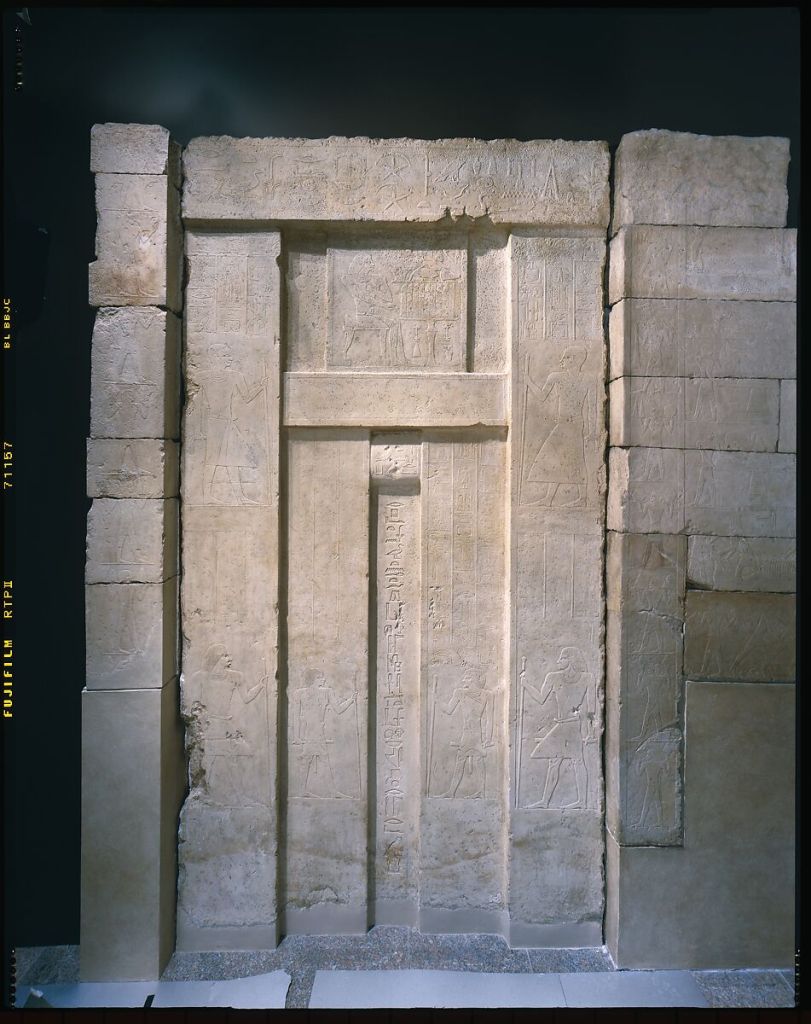
Reflecting on doors in the archaeological record, I can’t help but mention ancient Egyptian false doors. They were carved niches in tombs which resembled doors, except they had no opening. They functioned as a threshold between the worlds of the living and the dead, allowing the dead to enter and exit freely, but not the living. There’s one in the Metropolitan Museum of Art dating to ca. 2446–2389 B.C (purchased in 1908, go figure). What’s incredible about this particular example is that it was originally dedicated to a different official and then re-used, with the imagery representing a more mature man removed.
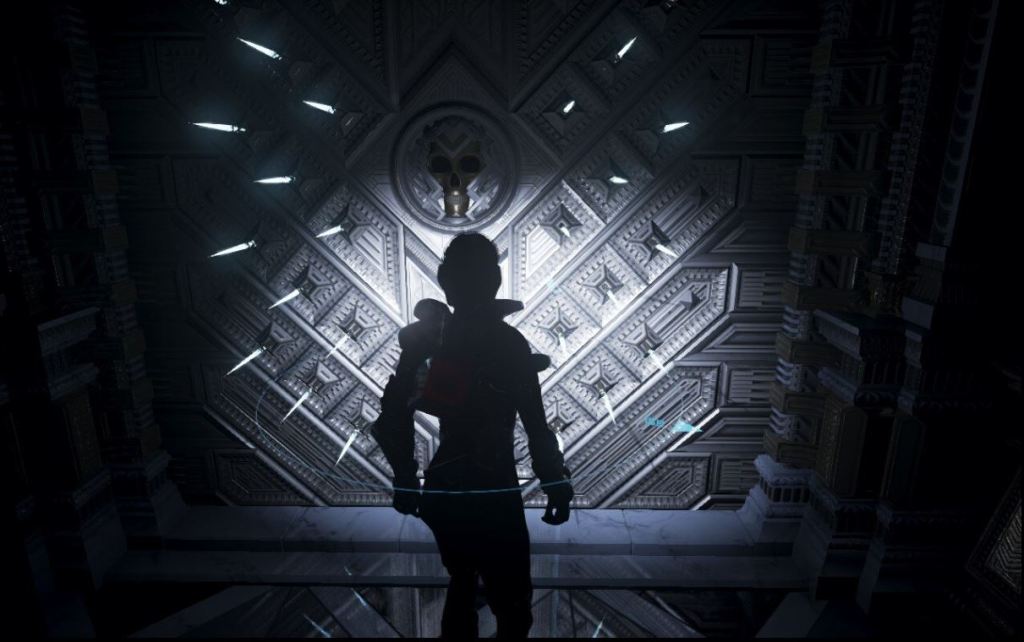
False doors like this have their echoes in the “doors for decoration” that Liz England mentions in video games. A fake door can be set-dressing to make a digital world feel bigger than it actually is. My favourite example of this is from the sci-fi stealth game ECHO, in which you traverse an endless palace on an alien planet. Also, funnily enough, you have to fight copies of yourself – a theme of doubling that it shares with Severance. The endless gilded baroque halls you wander often feature rows of identical doors, but of course you can’t enter them all. In ECHO, rather than the false doors just being inert, if you walk towards them the face adorning them will turn into a skull and luminescent spikes will unfurl. This dynamic response further creates the illusion of an inhumanely large space that could have countless secrets hidden behind closed doors.
Threshold Leapers
In the Bible, God would punish those who think that if they leap over the threshold of his temple, they can prevent evil spirits from entering, thereby trusting in superstition instead of Him. Doors are sites of anxiety; what can they let in, what do they keep out? To imagine that they are ever fool-proof would indeed be hubris, as Lumon discovered when their severed employees found a way to bypass their containment and enter the outer world.
Doors are not absolute. They leak. Perhaps, after reading the many design considerations of doors in games, it would be unfair to complicate them further. Yet, as a mundane world building material, what other experiences can we unlock through doors in fictional worlds? A door is not just access to a space, it is also access to power, knowledge, a person. Whatever we bury there, whatever we seek to lock away, surely will find another route back to us. After all, where was the creator of Severance working when he came up with the idea for the show?
A door factory.
 Florence Smith Nicholls